HACKATHON 2025
Winners: HACKER TRACK
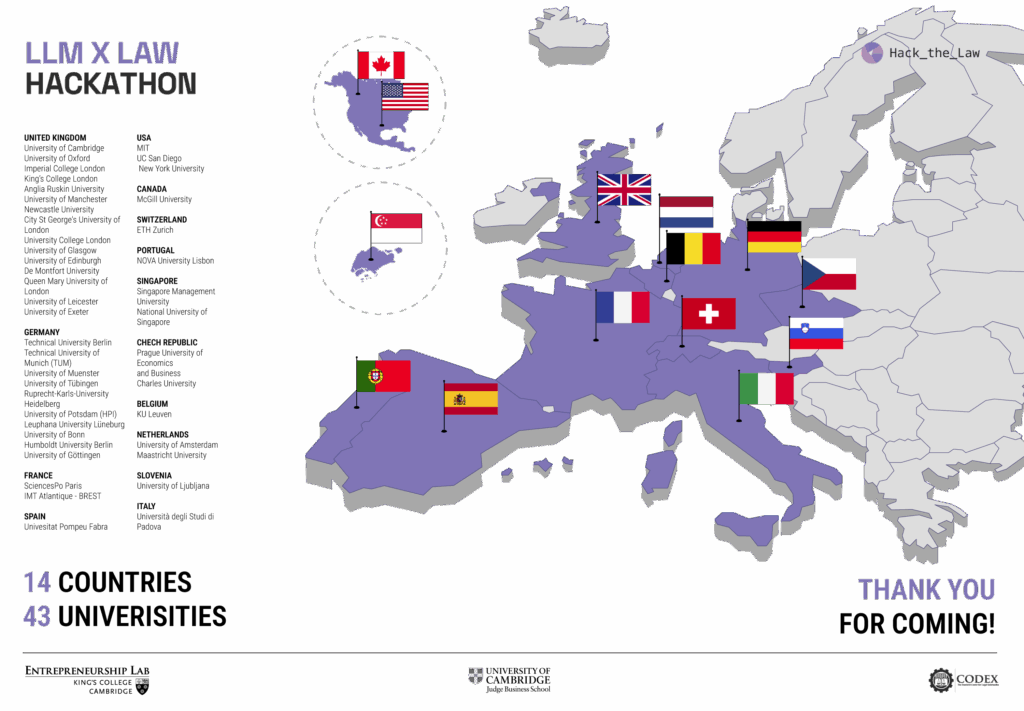
Students of different backgrounds from around the world competed to solve real-world legal challenges provided by our sponsors and partners. In just one day, teams built solutions from scratch and pitched to academics and law/tech firms for cash and non-monetary prizes.
Hacker Track Winners
Counter Claim Eagle
Winner of the 2025 LLMxLaw Hackathon (£10,000)
Winner of the Stanford CodeX x Jus Mundi Challenge
Runner-up of the Google Cloud Platform Best Tool Use
Team members: Julia Volovich
CounterClaim Eagle is an AI Co-Counsel tool which leverages advanced LLM agents and a risk simulator to challenge opposing arguments with precision and depth. It tests counterclaims against precedent, highlights weaknesses in rival positions, and simulates litigation outcomes using Monte-Carlo methods. By programmatically analysing large volumes of case material, it crafts data-backed rebuttals and delivers them with visual clarity. Built-in safeguards—such as citation-backed responses, code-driven calculations, and programmatic prompting—ensure reliable, scalable performance even on complex or lengthy legal documents.
Dialogue AI
Runner-up of the 2025 LLMxLaw Hackathon (£5,000)
Runner-up of the Google Cloud Platform Best Tool Use
Team members: Alexander Pleaster, Alina Ahmed, Nivar Anwer, Valentin Colomer, Jordan Baumard
By orchestrating three specialized Gemini AI instances in a structured adversarial framework, our solution rigorously tests legal strategies from every critical perspective, identifying factual inconsistencies, jurisprudential vulnerabilities, and strategic weaknesses in real-time. Seamlessly integrating Jus Mundi’s arbitration database through advanced API-driven semantic matching, our solution retrieves and analyses relevant precedent cases, delivering predictive analytics and visually compelling, interactive insights. This technical synergy empowers arbitration lawyers to refine their arguments, anticipate tribunal responses accurately, and confidently build precedent-based winning strategies in complex, high-stake disputes.
No Human Intelligence
3rd place of the 2025 LLMxLaw Hackathon (£2,500)
Winner of the Brown Rudnick Challenge
Team members: Daria Godorozha
No Human Intelligence is a comprehensive legal analytics pipeline designed to estimate and evaluate litigation versus settlement outcomes. It integrates data collection from sources such as PDFs, dockets, and spend ledgers, with capacity for web/database scraping and synthetic data generation. For text processing, it utilises transformer-based models including Facebook’s BART-large-mnli for text annotation and T5 for LLM callibration. It incorporates LightGBM classifiers calibrated with scikit-learn’s Calibrated Classifier CV for predicting litigation outcomes. The pipeline also includes policy parsing with regular expressions, sophisticated feature engineering and risk assessment simulations employing Monte Carlo methods. It outputs key financial metrics such as average returns, variability (standard deviation), the probability of superior litigation outcomes, and discounted present values to guide informed decision-making.
Know Your Rights
Access to Justice Special Prize (£2,000)
Winners of the Bar Standards Board Challenge
Team members: Laksshini Sundaramoorthy, Hidde Heijnen, James Xu, Leonhard Vulpius
KnowYourRights educates citizens about consumer protection law, addressing the power imbalance between consumers and traders. Our app improves legal literacy regarding Consumer Rights Act protections. Users input information, which is summarised and processed to remove biases—we found emotive language reduced refund chances by 7.5%. The cleaned data undergoes tree traversal, breaking legal reasoning into discrete steps rather than “one-shotting.” The system scans headers for relevance, examines specific legislative sections, and navigates between them as needed, mimicking how lawyers actually work with legislation. The process delivers two outputs: a practical solution for the customer and a detailed history log documenting all steps taken.
Lexathon
Winners of the Google Cloud Platform Best Tool Use
Team members: Sarka Juklova, Laura Peirs, Matthre Kelleher, Maxim Gusev
As a play on the words “go to court”, “grow to court” platform is an AI-powered simulation to support the professional development of (junior) lawyers. By replicating real-world legal scenarios (from negotiation to drafting to client communication) it preserves the traditional mentorship model in a digital-first environment. The platform offers a “mentor chat”, skill-building opportunities, and guided practice to help junior legal professionals grow in judgment, confidence, and capability.
Law Croissant
Winners of the RegGenome Challenge
Winners of the Mistral Best Tool Use
Team members: Bocheng Xiao, Dunyuan Zha, Yuchen Mao
Law Croissant is automating compliance with Multi-Agent intelligence System. This AI-powered regulatory compliance system that automates the analysis of complex financial regulations using a multi-agent architecture. The solution extracts key terms, sources definitions, and maps relevance across regulatory documents, transforming weeks of manual compliance review into minutes of automated analysis through Mistral LLM integration.
Just 3
Winners of the Groq Best Tool Use
Team members: Xavier Doni, Sanay Shah, Siyuan sui
Just 3 solution provides a searchable, intuitive interface for compliance professionals to explore and understand complex financial regulations by structuring them and highlighting key entities, activities, and products.
eLegal
Winners of the Linklaters Challenge
Winners of the Momen Challenge
Team members: Nils Lilienthal, Philipp Hilpert, Vadym Kuzmenko, Julia Dänzer-Vanotti
eLegal’s “Lawrion” solution ensures that companies stay fully up to date with the latest relevant regulatory developments. By providing instant, structured summaries and risk-based categorisation of regulations, we eliminate delays in identifying critical changes, reduce compliance risk, and enable smarter, faster adoption of new requirements. In our prototype, we focused on regulatory updates tailored to banks, financial institutions, and companies subject to Supreme Court decisions, FCA or Bank of England publications. Large law firms such as Linklaters can use the tool to deliver sharper, faster, and more informed advice to clients — highlighting which regulatory changes should be prioritised, and turning legal updates into strategic advantage.
Risk IQ
Winners of the Luminance Challenge
Team members: Omowonuola Adekanmbi, Kayode Adeniyi, Favour Ifi Egoamaka
Risk IQ is an enterprise contract risk intelligence platform that monitors regulatory changes and economic events in real-time, automatically assessing their impact on existing contracts at the clause level. The system ingests data from multiple regulatory feeds (Cellar API, OFAC sanctions), processes it through dual AI pipelines—vector similarity matching and taxonomy-based rule verification—then generates actionable risk scores (Green/Amber/Red) for each contract clause. Built on GCP with a GraphQL API and Next.js dashboard, it transforms manual contract review into automated, real-time risk monitoring.
Vibe Legal
Winners of the Clifford Chance Challenge
Team members: Beatrice Furniss, Sarah Attie, Anh Dao Dang, Joe Sadiq
Vibe legal is a lawyer-only team that developed LexMentorAI: a tool designed to support the development of junior lawyers by assisting them in three key areas. First, the document review functionality allows mentees to upload documents for analysis, with the tool highlighting and flagging certain clauses along with suggested improvements or replacements. Second, it includes a negotiation simulator that offers scenario-specific exercises, with AI-generated graded feedback based on various sources for evaluating negotiation responses. Third, the tool features a Q&A database that enables juniors to access specific templates or inquire about particular rules in the company’s handbook.
SMU LIT
Winners of the Legora Challenge
Team members: Xie Wen Kai, Gui Le-Shaine Hannah, Ivy Wong Rui Lin, Reg Sim Yu Jian, Daniel Tan Wei En
LIT Legal Mind (LLM) is an AI-powered legal memory system that streamlines contract drafting by intelligently managing and reconciling information from multiple, often contradictory legal documents. The platform addresses the “invisible thread” problem in legal practice—where lawyers must track, recall, and reason across numerous documents—by providing an all-inclusive pipeline prototype that reduces the complexity of multi-document cases and accelerates contract drafting workflows.
JusticeGPS
Winners of the vLex Challenge
Team members: Yusuf Morsi
JusticeGPS is an AI assistant that guides users through UK civil procedures and arbitration strategies using legal rules and real case data. The dual-mode platform combines CPR/Practice Directions analysis with international arbitration strategy assessment, featuring a self-refinement loop where every response is critiqued and rewritten for accuracy. It provides explainability toggles, confidence scoring, visual analytics with procedural flowcharts and precedent heat-maps, and delivers real-time legal analysis with source citations, achieving 96% accuracy in testing.
New Horizon
Winners of the Simmons & Simmons Challenge
Team members: Dequn Teng, David Adeyemi-Abere, Peiju Li, and Helen Linhan Su
JuriSpark is an AI tool that creates knowledge graphs to analyze legal expert reports, extracting entities, relationships, and arguments to map how different experts’ views support or contradict each other across litigation documents. Built on three pillars—a knowledge graph analysis engine, generative AI strategy assistant, and debate simulation platform—it systematically processes PDFs to identify people, organizations, legal terms, financial data, and temporal events while mapping argument chains (primary claims, supporting evidence, counter-arguments) and their stances. The system provides natural language querying, interactive network visualizations, and temporal analysis through both command-line and Streamlit web interfaces.
All 2025 Challenges
All 2025 Tools
Winners: STARTUP TRACK
Founders and regional hackathon winners with existing LegalTech projects pitched their solutions to investors, incubators, and accelerators. Teams presented demos to seek funding, partnerships, and growth opportunities.
futurist law lab
General Catalyst Award
Winners of the Legal Frontier Hackathon: AI & Beyond (Netherlands)
Team members: Matthew Kelleher, Sarka Juklova, Laura Peirs
Futurist Law Lab is an AI compliance agent built for startups that can’t afford dedicated compliance teams. With the EU AI Act now in force, developers face significant fines if their code doesn’t meet regulatory standards. The tool plugs directly into GitHub repositories, scans code automatically, and generates compliance reports that satisfy EU AI regulatory requirements. It turns regulatory burden into an automated workflow—letting small teams ship compliant AI products without hiring lawyers or compliance specialists.
tracy ai
Winners of the Law Brainer AIxLaw Competition (Slovenia)
Team members: Oliver Majer, Fedja Močnik
Tracy AI is a multistep code agent that automates T&C analysis for law firms. It ingests terms and conditions documents via a proprietary API-connected database, then processes them using deterministic rules rather than probabilistic LLM outputs—reducing hallucination risk. Tracy flags, classifies, and highlights controversial clauses, then generates compliance assessments against specific regulations. Each decision is traceable through its rule-based logic, providing audit trails that pure LLM systems can’t deliver. By automating what typically takes hours of manual review, it lets legal teams scale compliance work without sacrificing accuracy or accountability.
AI4G: ARTIFICIAL INTELLIGENCE FOR GOOD
Runner-up Winners at Toronto LLMxLaw Hackathon (Canada)
Team members: Monika Koestner, Richard Trus
AI4G’s app “Hallucin8” is an AI system that mines the Canadian Bar Association’s class action database to identify litigation trends and predict case viability. It aggregates historical case data—outcomes, settlement patterns, judicial behavior, procedural timelines—and uses pattern recognition to assess whether a potential class action has legs. Law firms input case parameters, and Hallucin8 surfaces comparable precedents, flags procedural pitfalls, and quantifies likelihood of certification or settlement based on past data. Rather than relying on manual research through scattered databases, it turns decades of class action history into actionable intelligence. The system helps firms make go/no-go decisions faster, allocate resources to winnable cases, and advise clients with data-backed confidence instead of gut instinct.
REVAX
PwC NewLaw Award
Team members: Alex Bartlam
Revax is a RAG-powered drafting tool built for M&A tax advisors. It ingests precedent reports into a searchable knowledge bank, then uses an agentic LLM pipeline to surface relevant language and generate new client reports. Instead of manually hunting through past work and copy-pasting sections, advisors query the system and receive draft text pulled from their own precedent library. The RAG architecture ensures responses are grounded in actual past reports rather than hallucinated content, while the agentic workflow handles multi-step reasoning—like identifying comparable deal structures or jurisdictional nuances. It turns days of precedent research and drafting into minutes, letting tax teams focus on strategy rather than document assembly.

legalgraph ai
Point72 Ventures Award
Team members: Mahesh Yadav
LegalGraphAI is a customisable AI agent platform for contract work. Instead of forcing legal teams into rigid CLM workflows, it lets lawyers build their own agents using plain English—no coding required. The system learns from your playbooks and past redlines, then applies your firm’s judgment to draft contracts, flag risky clauses, and generate review reports. Agents show their reasoning for every decision, so you can validate logic and correct course when needed. It handles bulk portfolio analysis across dozens of contracts, extracts key terms into structured data, and automates compliance tracking for renewal dates and obligations. The platform deploys in your own cloud or theirs, with encryption and guaranteed data privacy—your contracts never train their models without consent. Built for firms that want AI that adapts to them, not the other way around.
TESTIMONIALS
It was a really nice event, the 1st edition is promising for the future, I’ll be delighted to help in the future from France. Thanks 🙂
I had such a great time learning from everyone.
A very big thank you to the team for pulling a great and impactful event. Would love to know the recruitment opportunities that may follow. Many thanks.
The hackathon was one of the best ‘educational’ events I participated in Cambridge and elsewhere. I had a lot of fun and met nice people.
All in all, a great hackathon. Thank you so much for organising and kudos to you for bringing so many sponsors and people from all over the world to Cambridge. We need more of that! Would love to support you in organising and hope to be at the next edition!
The diversity of the hackathon was impressive.
BLOGS
2025 Hackathon Reflection: CounterClaim Eagle, 1st place
2024 Hackathon Reflection: Dialogue AI, 2nd place
2024 Hackathon Reflection: No Human Intelligence, 3rd place
2024 Hackatho Reflection: KnowYourRights, A2J Special Prize
2024 Hackathon Reflection: Google Cloud Team
ORGANISERS
SPONSORS
DIAMOND SPONSOR
PLATINUM SPONSORS
HACKER TRACK SUPPORTERS
STARTUP TRACK SUPPORTERS
LOCAL SPONSORS