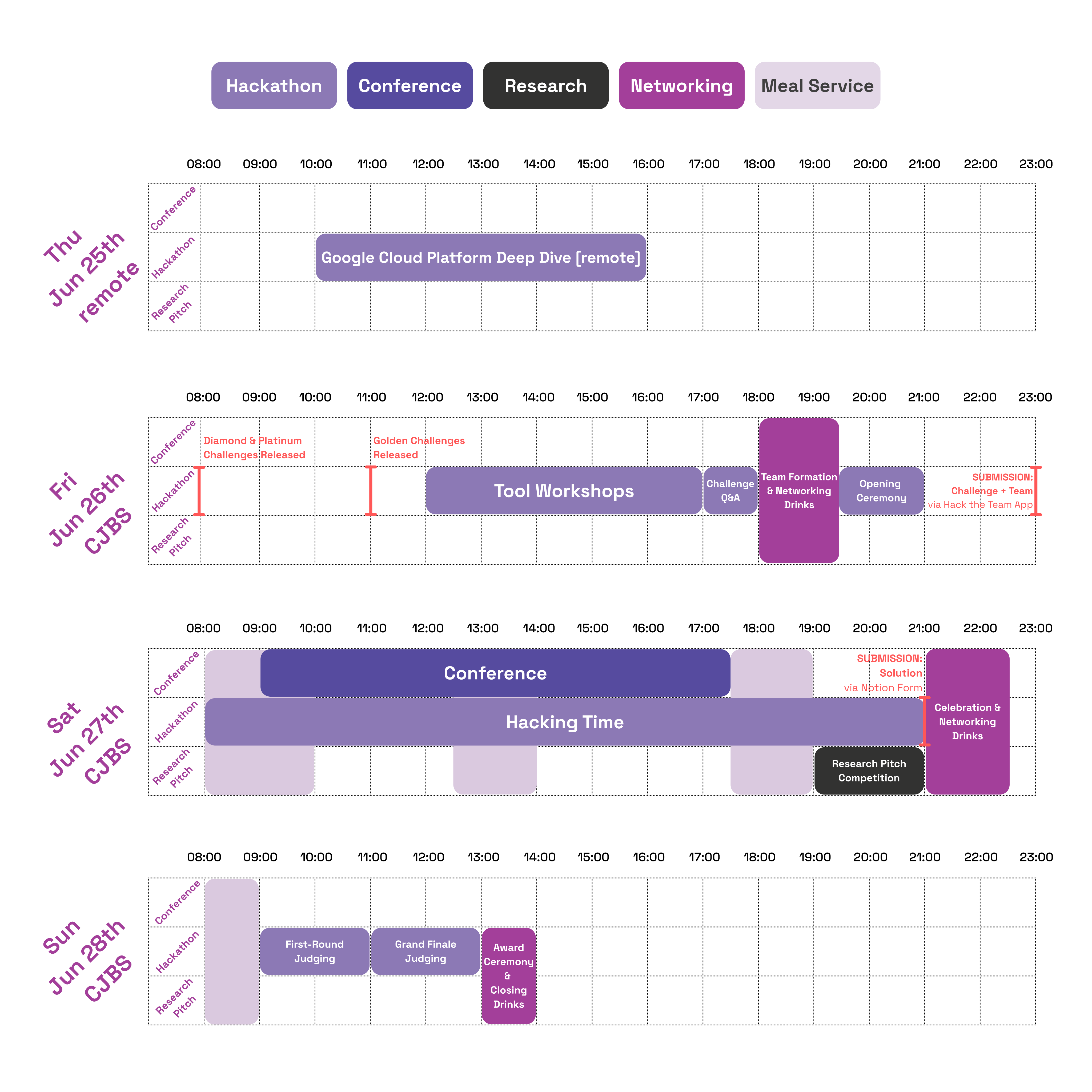
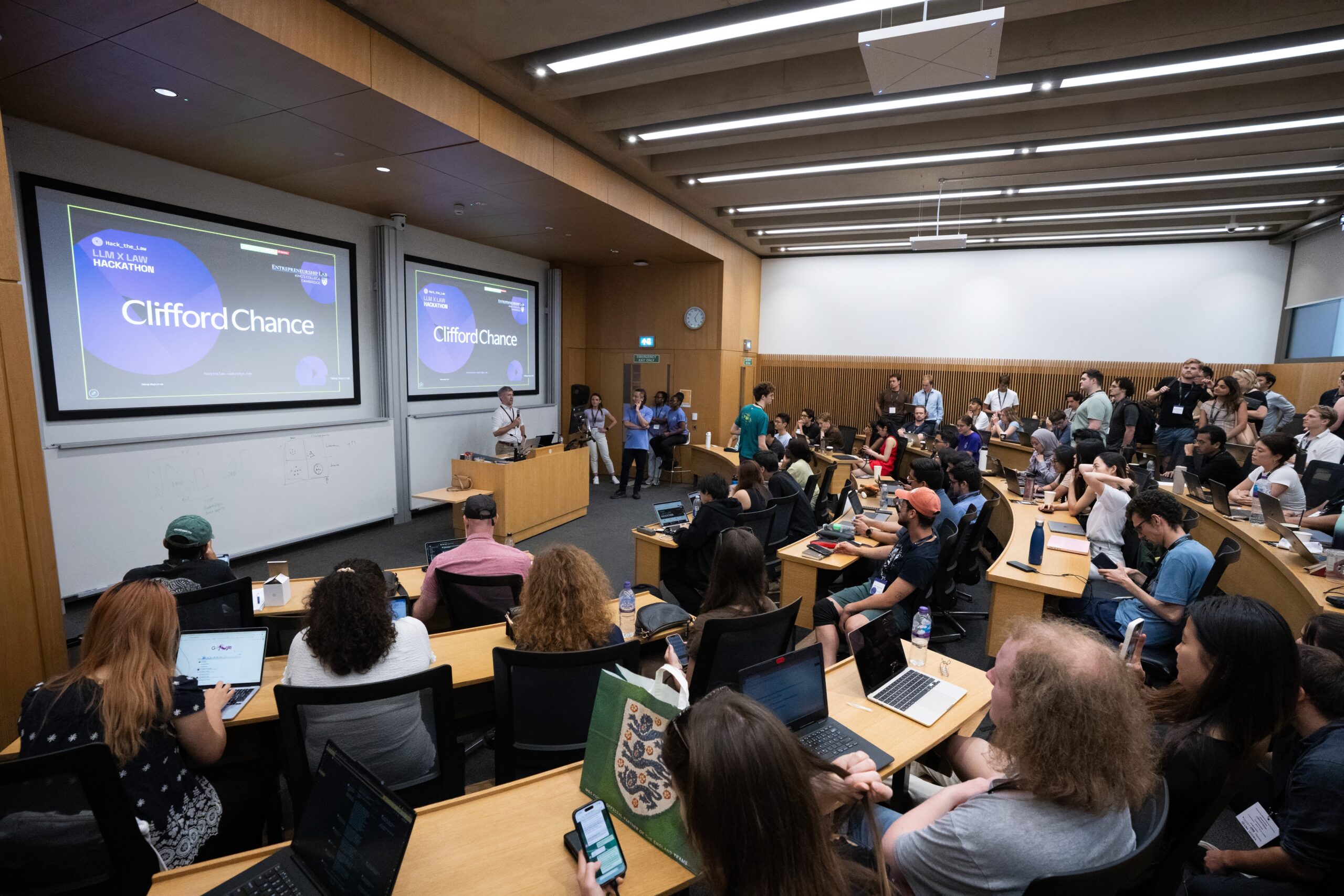
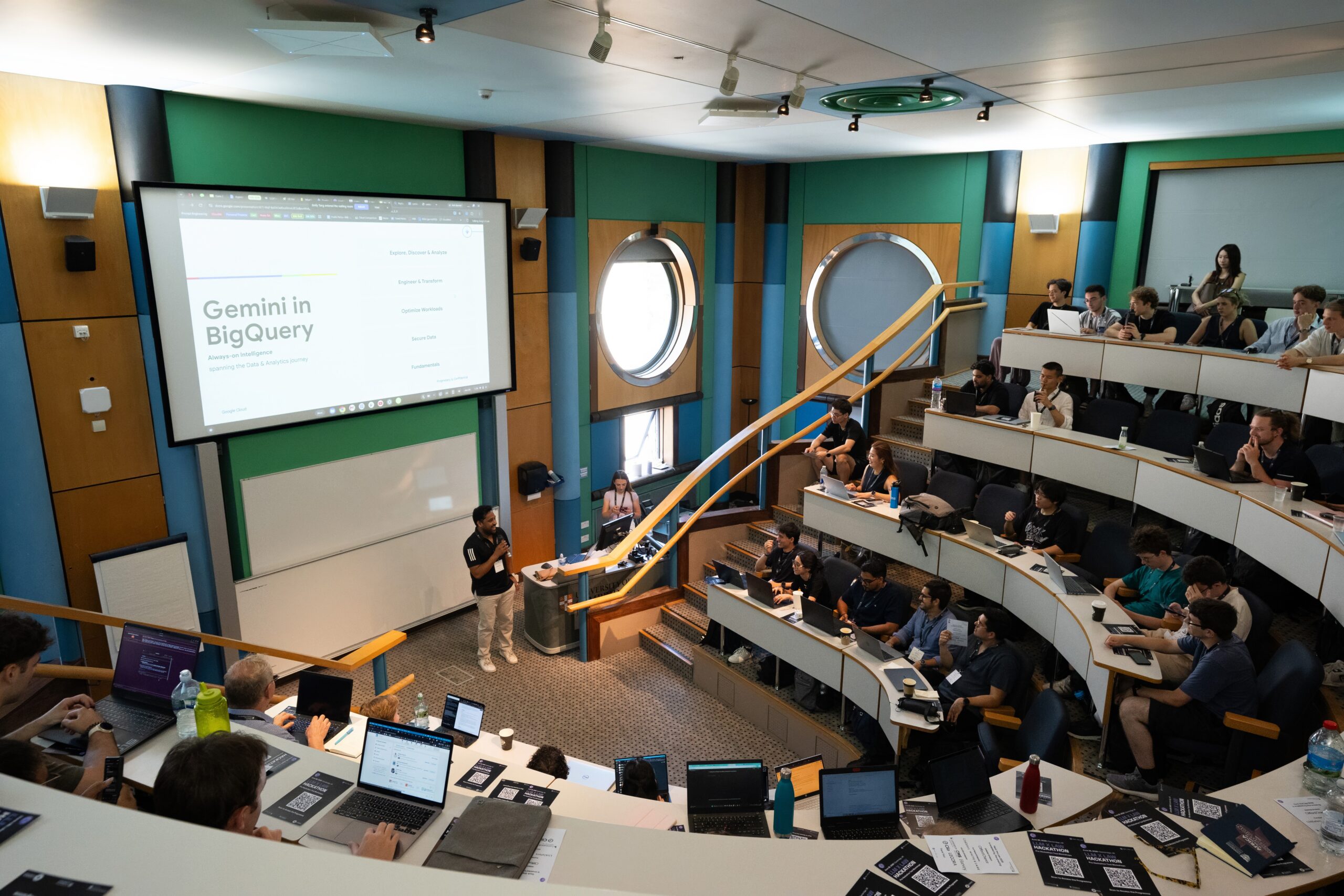
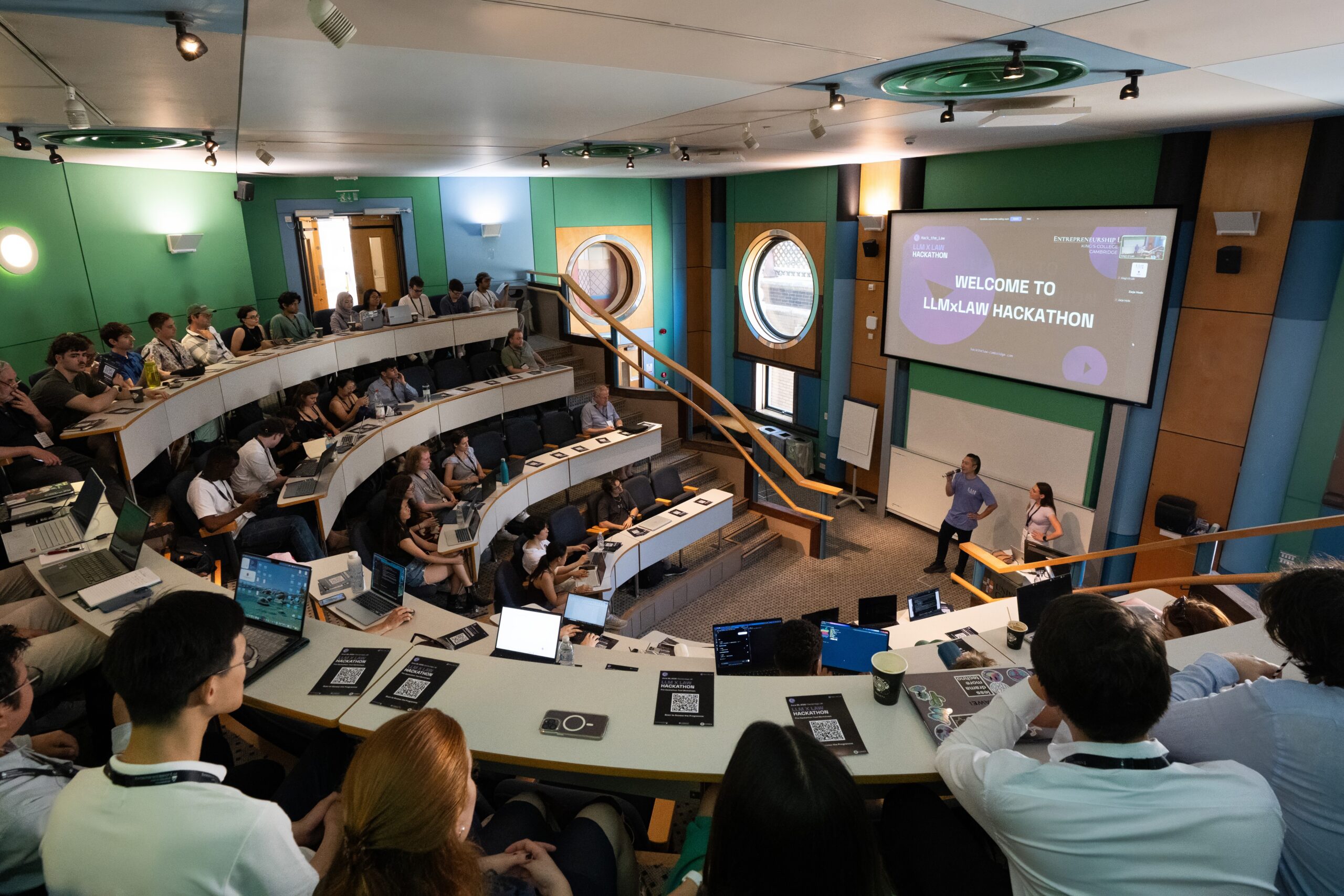
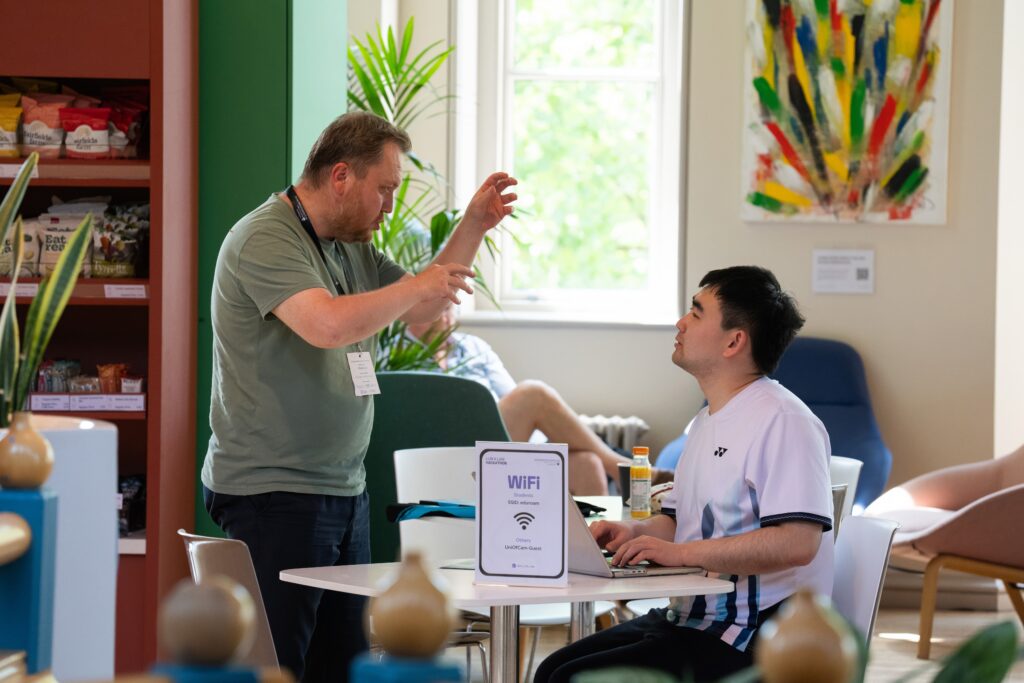
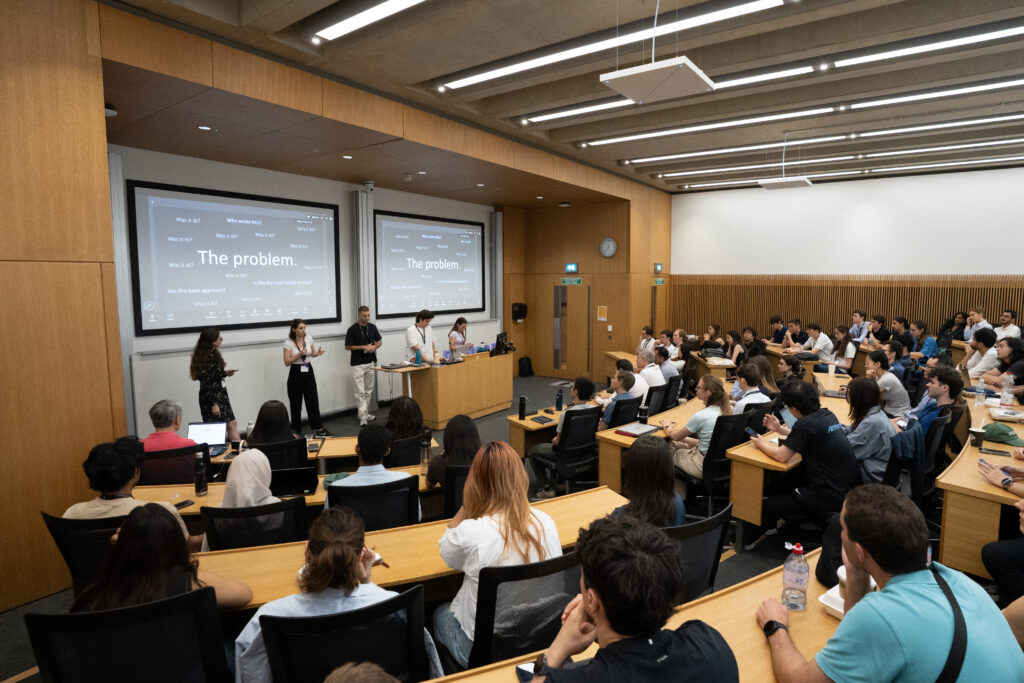
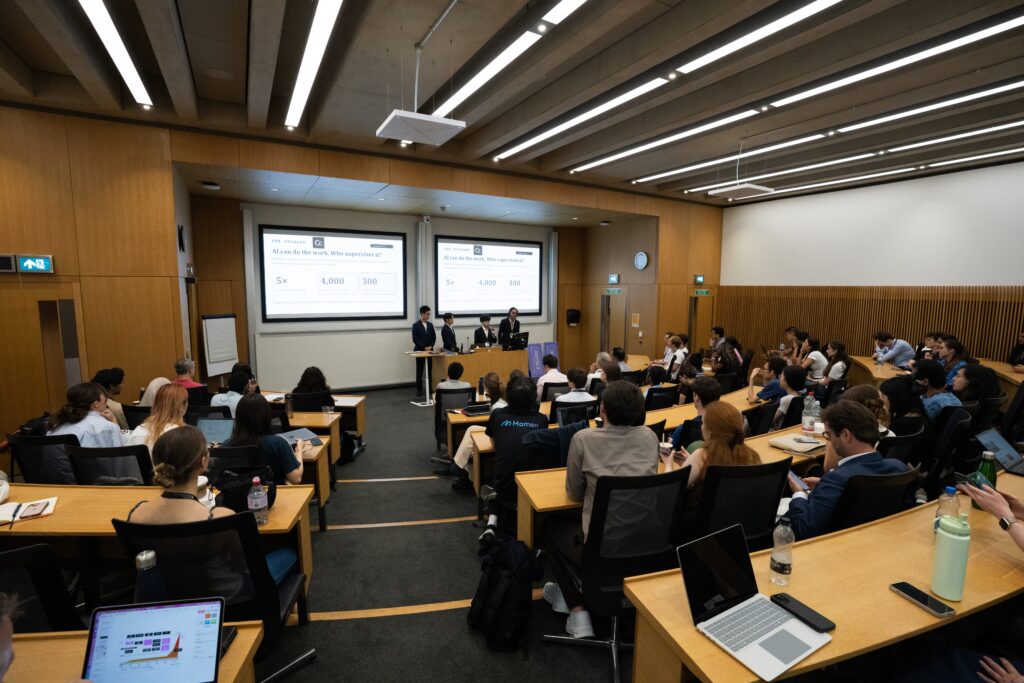
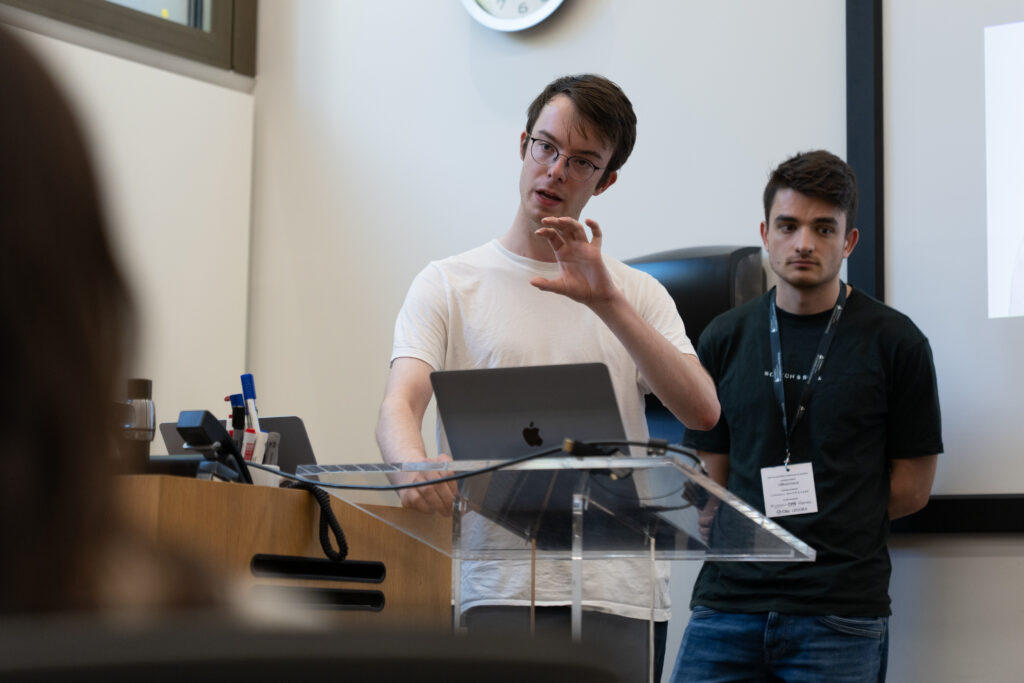
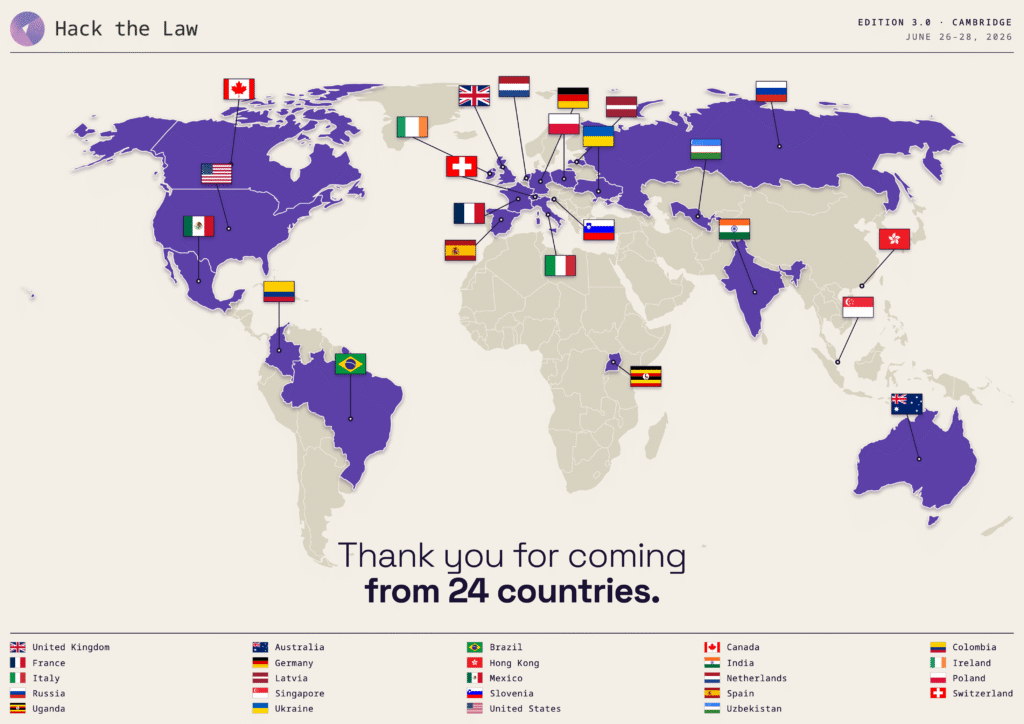
On Friday, dedicated workshops guided hackers through the tools, teams were formed, and an opening ceremony set the tone. Saturday was devoted entirely to building. On Sunday, teams pitched in two rounds.
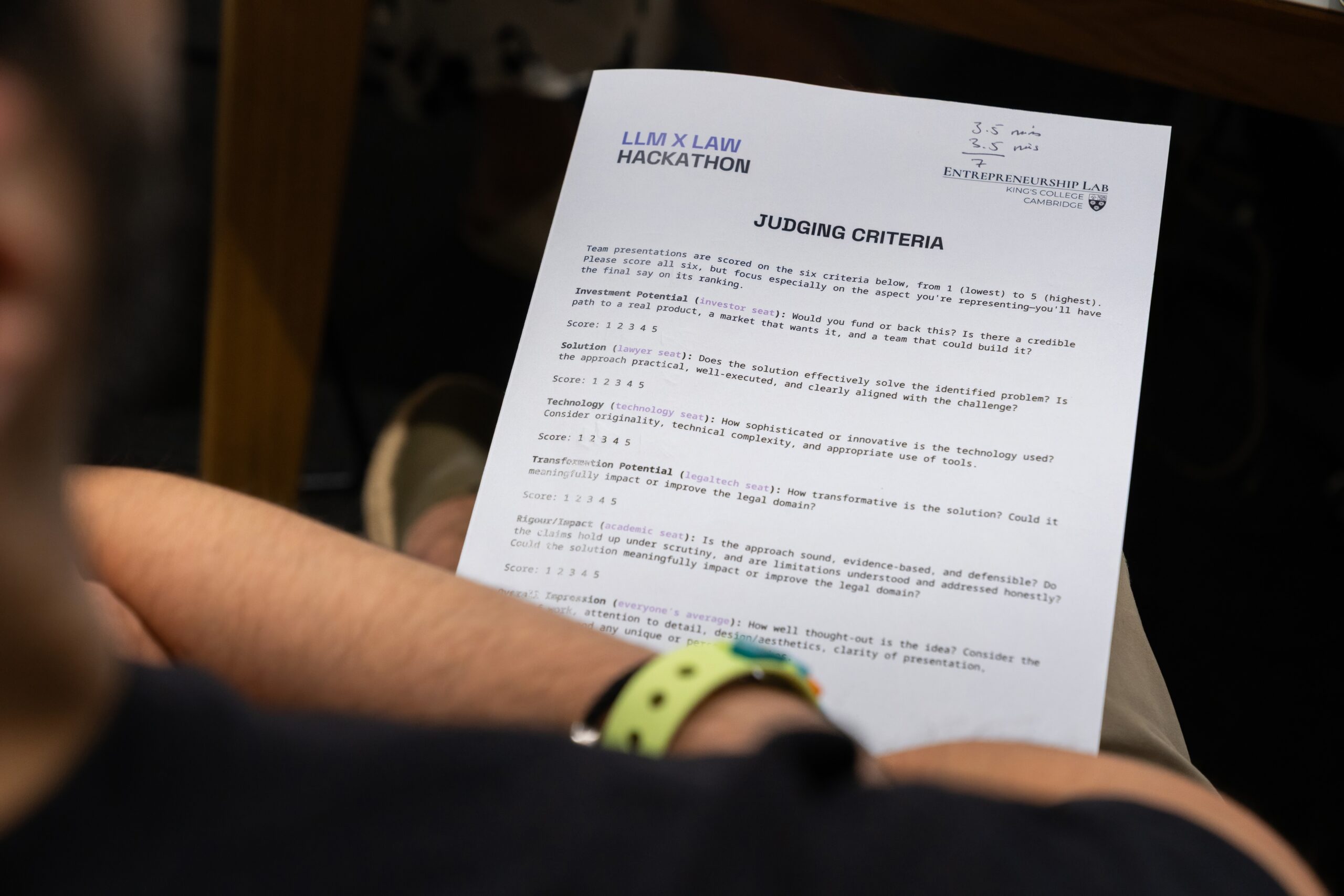
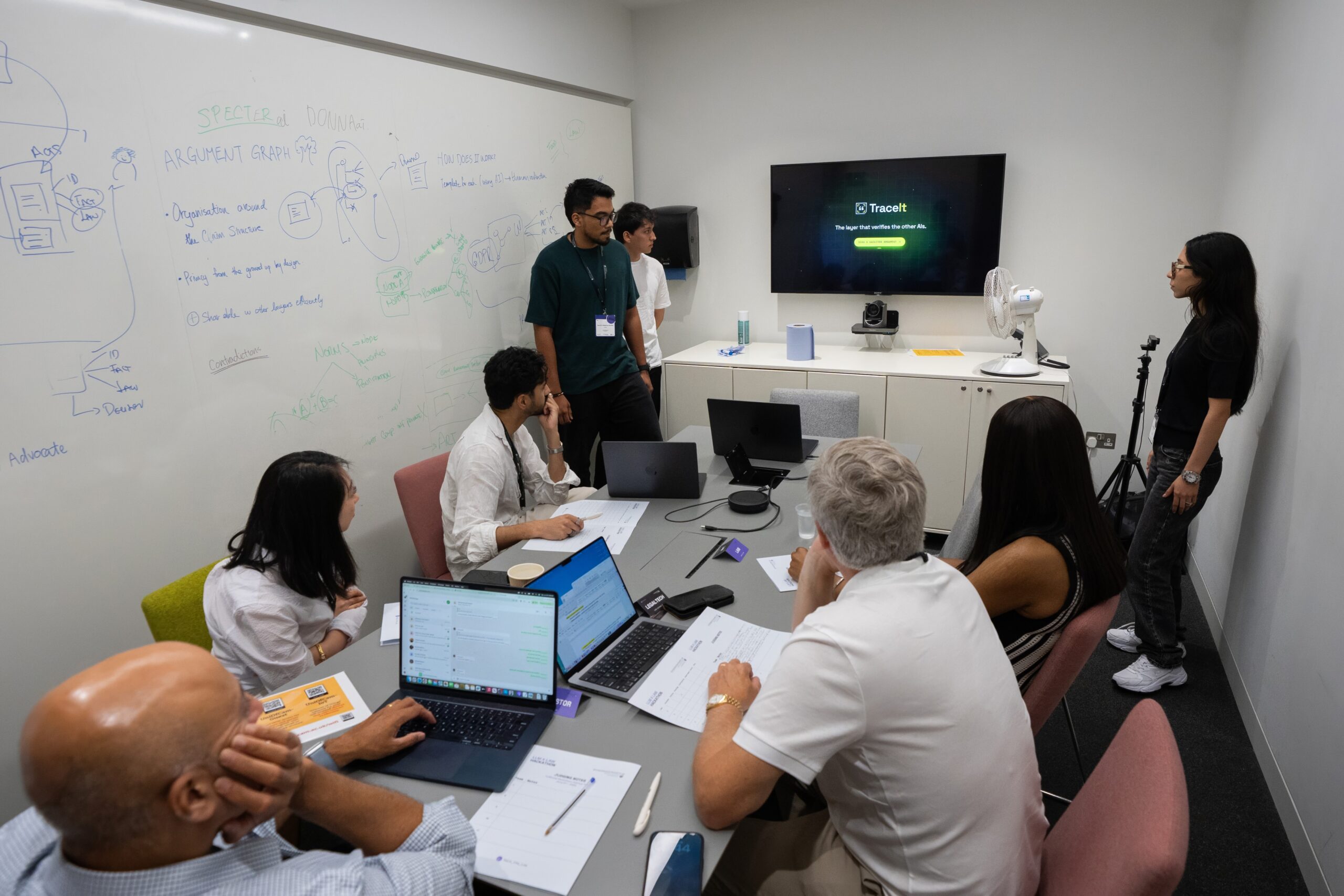
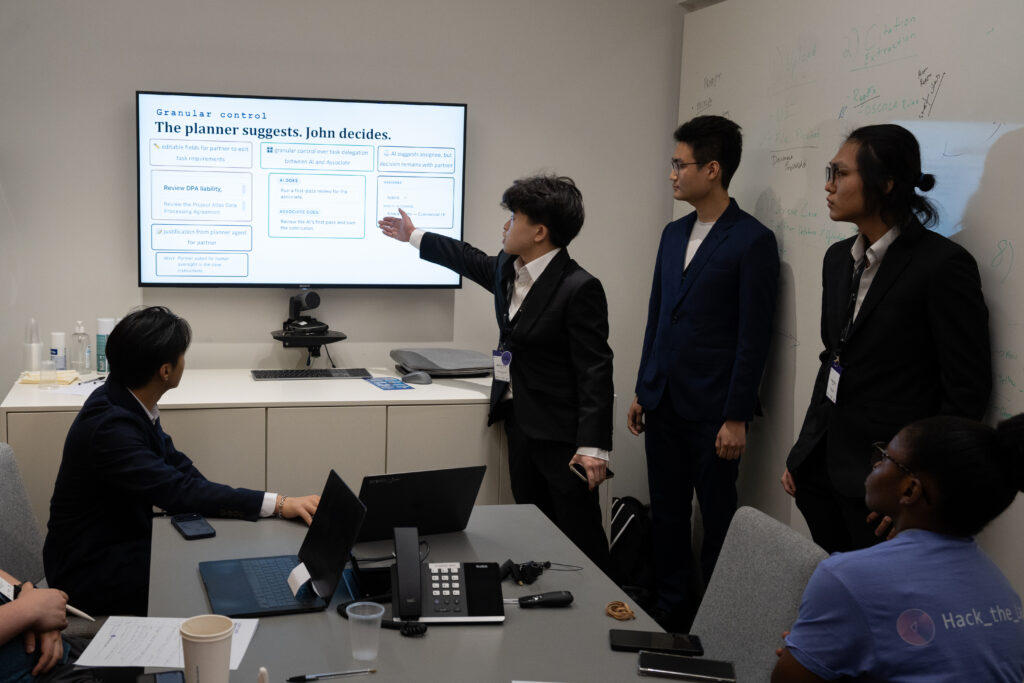
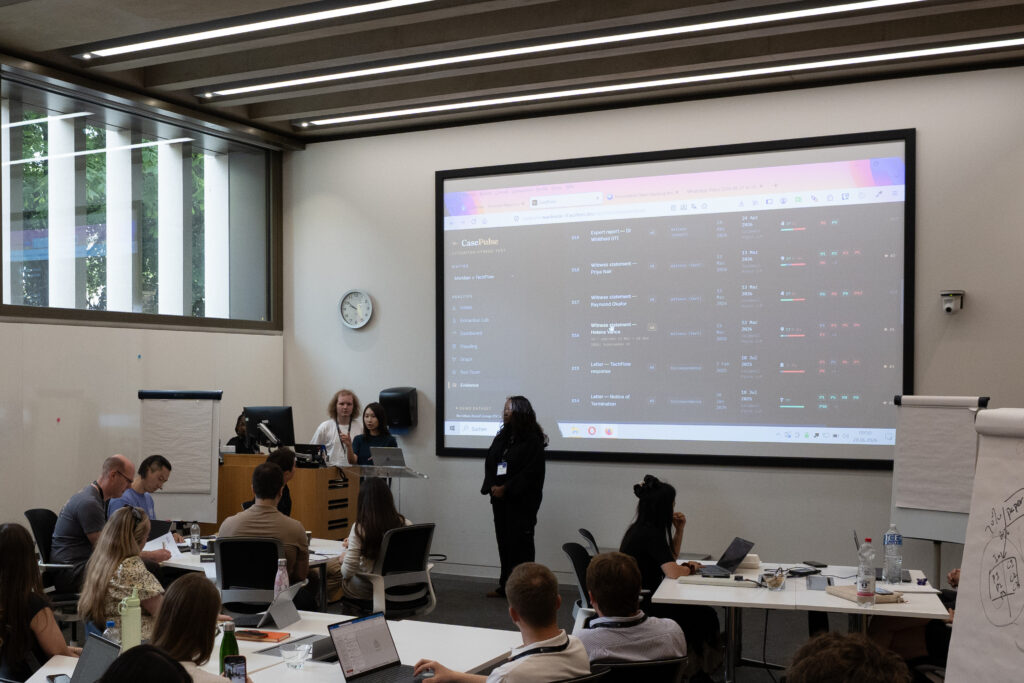
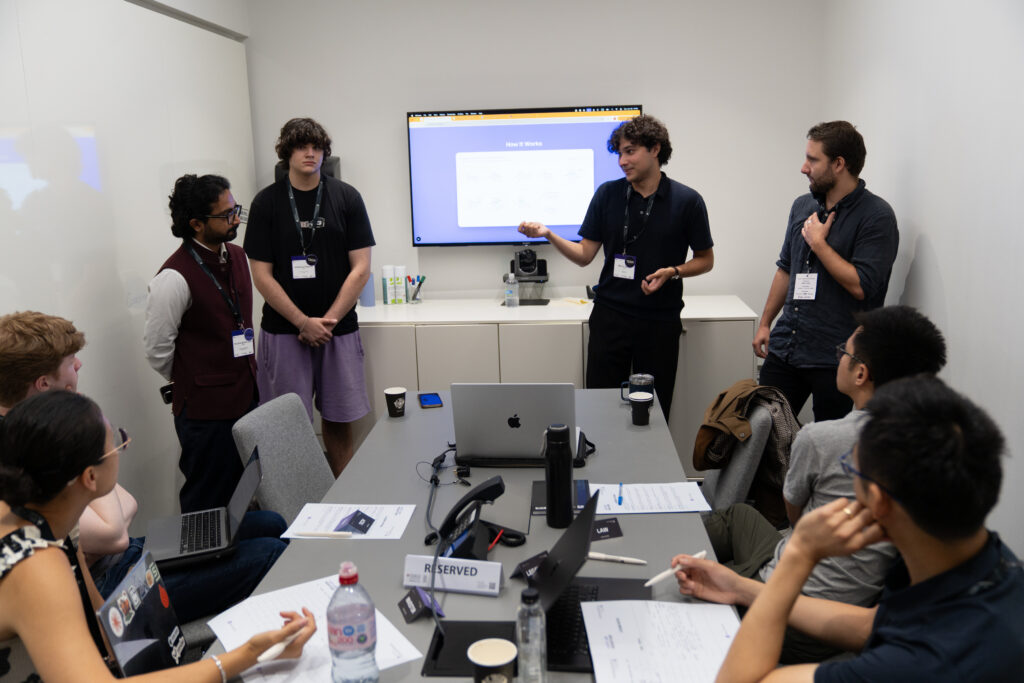
In the first round, teams pitched across five rooms, each assessed by a five-member panel. Every panel comprised a law seat, a tech seat, a legaltech seat, an investor seat, and an academic seat. The challenge winners and tool winners were selected by their respective owners, while the full panel shortlisted the top two teams from each room. These teams advanced to the grand finale.
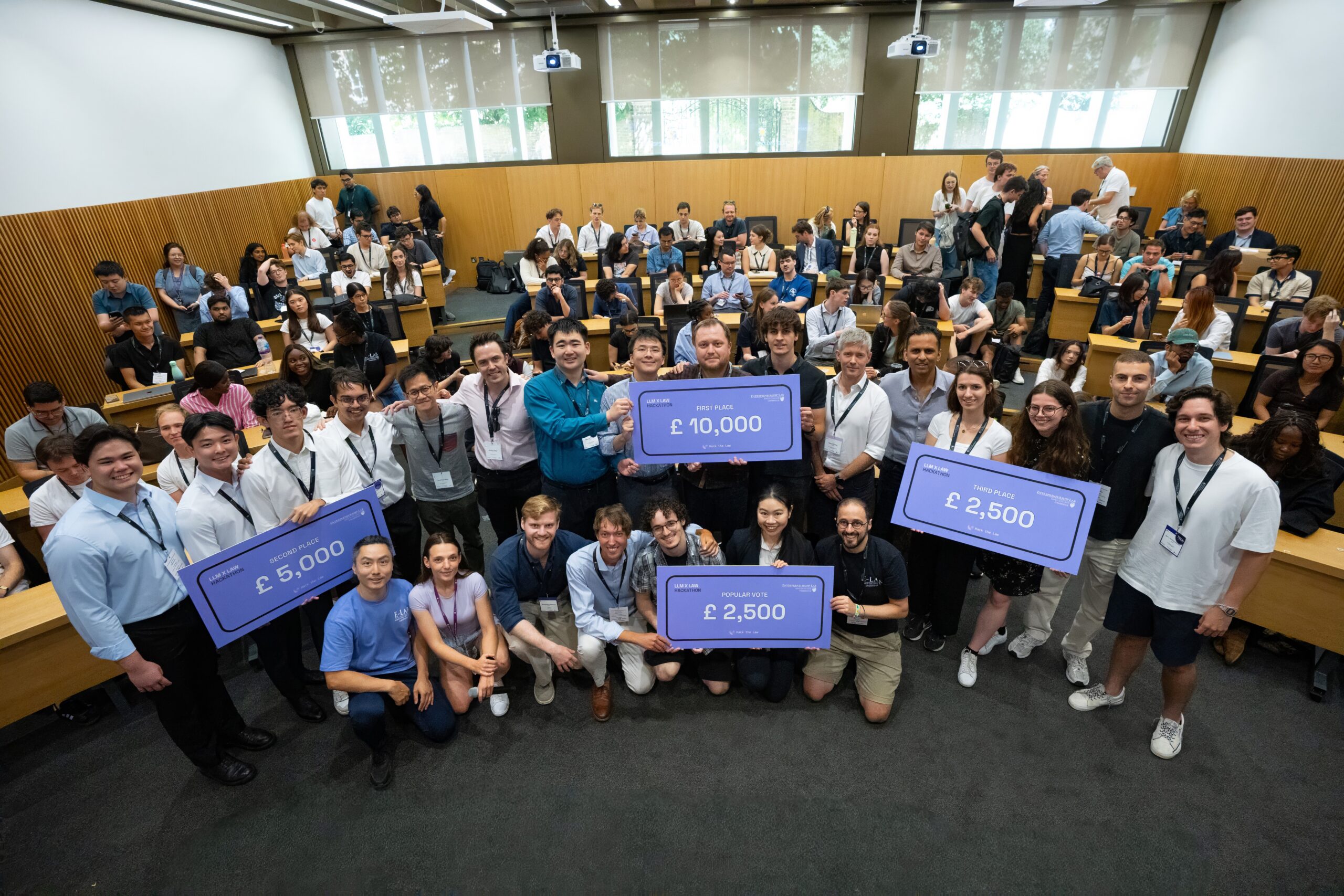
In the grand finale, hackers pitched before a panel of the two organisers (Cambridge and Stanford) and the three lead sponsors (Clifford Chance, Linklaters, and White & Case). This panel chose the three overall winners, and the audience selected its favourite.
Hacker Track Winners
Consistency Check
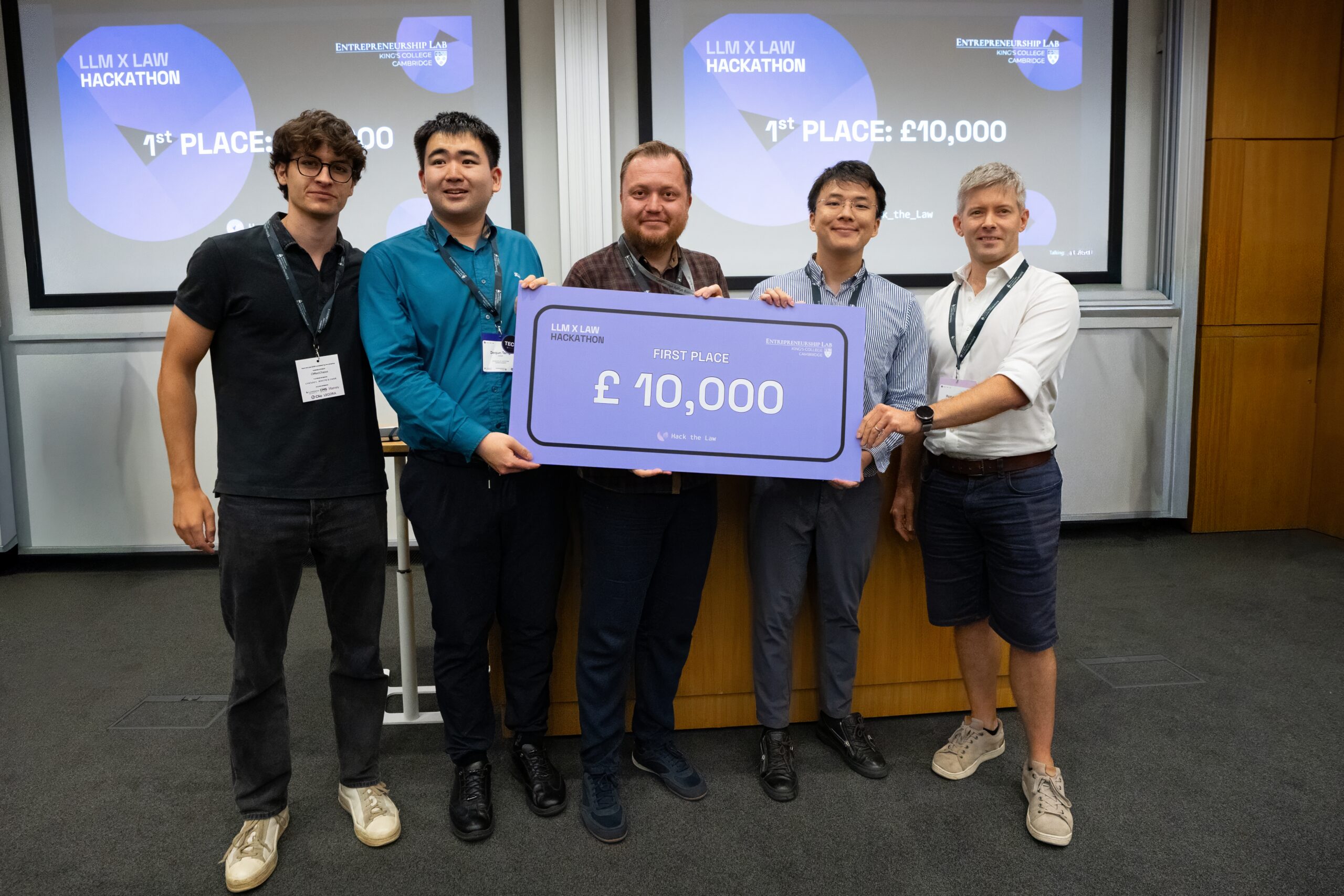
First Place Overall (£10,000)
Winner of White & Case Challenge
Tools Used: EU Publications Office’s data, Neo4j’s graph database, Anthropic’s Claude Code, Perplexity’s search and agents, NVIDIA’s Nemotron models
Team members: Dequn Teng (tech), Bernard Liu (tech), Mehmet Murat Cobanoglu (law), Arnau Salat (law)
Consistency Check is a citation integrity tool that safeguards legal documents against flawed or fabricated authorities. A lawyer uploads a draft submission, memo, or skeleton argument, and the system instantly identifies every cited authority, underlines it in place, and colour-codes it by risk. Its three-layer architecture pairs automated verification with human oversight at every stage. The Diagnostic Layer verifies each citation and assigns green, amber, or red flags depending on whether the authority is verified, questionable, or potentially fabricated. The Collaborative Review Layer supports lawyer review through tracked changes, recommended fixes, and one-click acceptance. The Training Layer turns every flagged issue into a learning moment, helping junior lawyers improve citation accuracy without removing human judgment. Rather than replacing legal review, the system gives lawyers a faster, clearer way to surface citation risks, correct problematic references, and maintain professional accountability before a document reaches a client, court, or opposing counsel.
Slides
GitHub
Demo
Challenge
Blog
SMU LIT
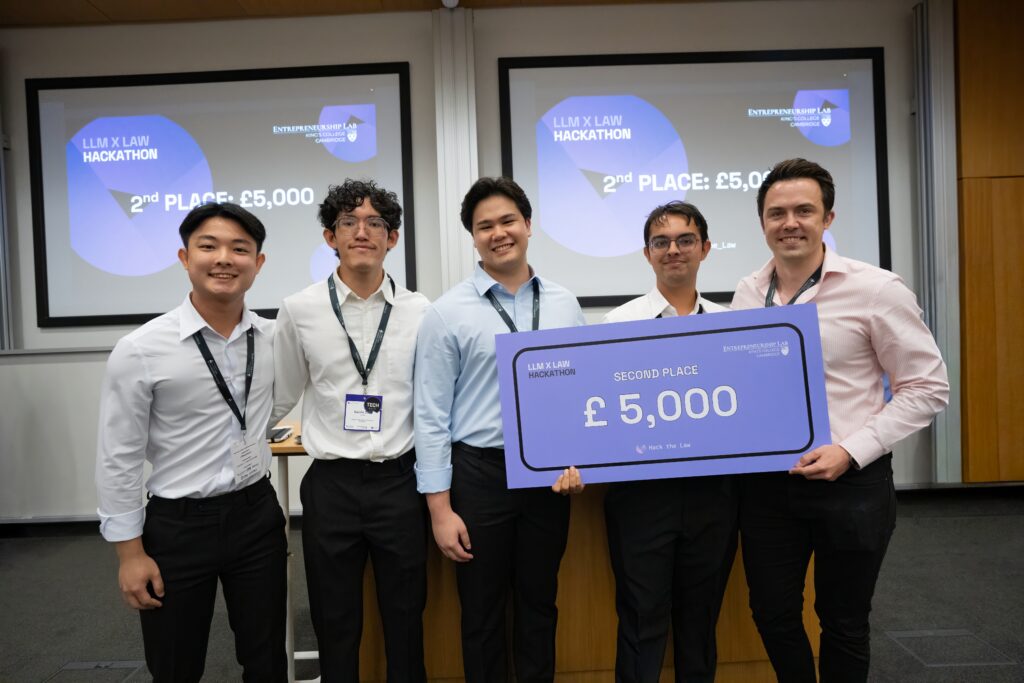
Second Place Overall (£5,000)
Winner of Legora Challenge
Tools Used: Anthropic’s Claude Code
Team members: Max Ho Zong Xian, Francis Chua Ern Chiat, Rajpreet Singh S/O Suckpal Singh, Kelvin Chik
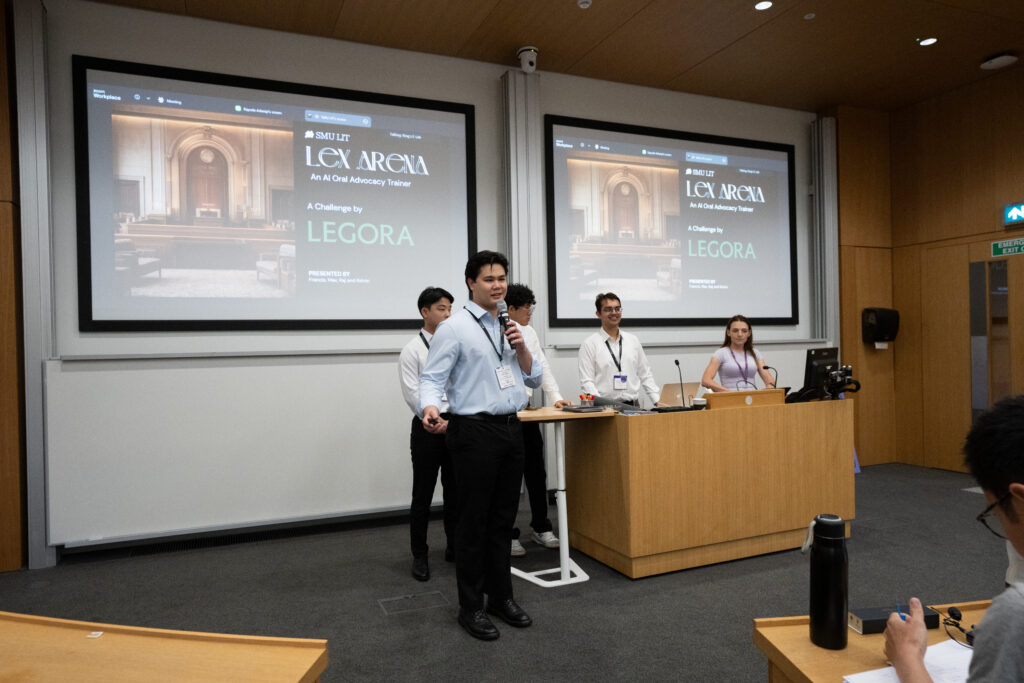
LexArena is an AI advocacy trainer that lets junior lawyers and law students sharpen their oral skills against a responsive opponent. Speaking aloud as they would in chambers or court, users face an AI judge or partner that listens to their voice inputs in real time, probes their reasoning, and presses them with pointed questions—just as a bench or senior colleague would. Multiple personas let users rehearse against a range of temperaments and questioning styles, from the sceptical judge to the demanding partner. After each round, the app delivers structured feedback that pinpoints where the user can improve, turning every session into targeted practice. By recreating the pressure of live questioning in a safe, repeatable setting, it builds the confidence and quick thinking that advocacy demands long before a user stands up for real.
Slides
GitHub
Demo
Challenge
Blog
QUINN
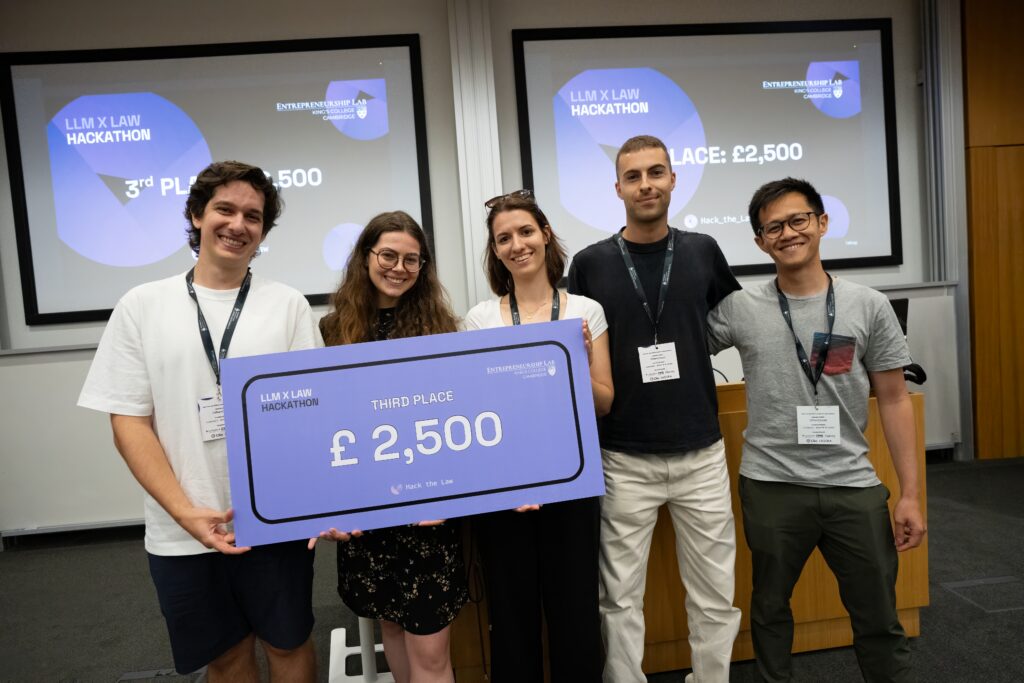
Third Place Overall (£2,500)
Best Use of Perplexity’s API
Tools Used: EU Publications Office’s data, Neo4j’s graph database, Anthropic’s Claude Code, Perplexity’s search and agents, NVIDIA’s Nemotron models
Team members: Amelie Sofie Sluiter (law), Annika Koch (law), Igor Lima Rocha Azevendo (tech), Leonardo Wink (tech)
Quinn is a supervision platform for human-AI legal teams. As firms delegate more document review and drafting to AI, the bottleneck shifts from “can AI do the work” to “can a partner trust and oversee it at scale”—and that is the problem Quinn solves. It brings every matter into one place, tracking who is working on what and logging exactly where AI has been involved, giving supervising partners the visibility they need to review and sign off with confidence. What sets Quinn apart is its structured knowledge graph: when new information arrives, it doesn’t overwrite an existing belief but timestamps when something was changed, by whom, and learned by Quinn, letting a partner scrub back through time to see exactly what was known and when. That temporal auditability is what turns AI-assisted legal work from a productivity tool into something a firm can actually govern and scale.
Slides
GitHub
Demo
Challenge
Blog
LawBridge
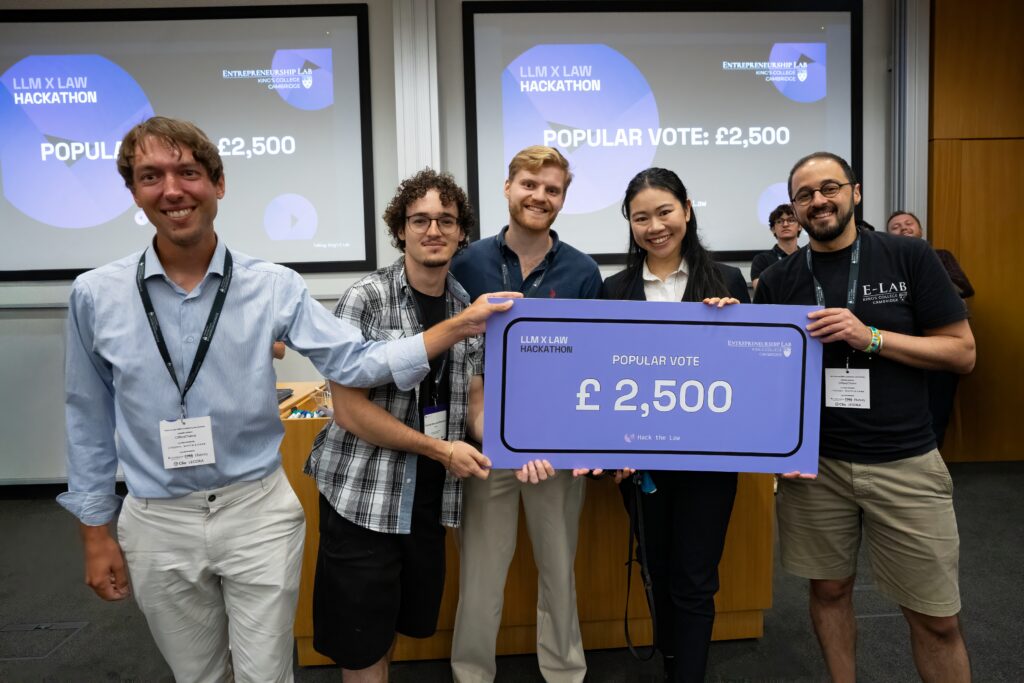
Audience Favourite (£2,500)
Winner of Linklaters Challenge
Tools Used: EU Publications Office’s data, Neo4j’s graph database, Anthropic’s Claude Code, Perplexity’s search and agents, NVIDIA’s Nemotron models, Google Cloud’s Platform
Team members: Alexandra Tran (Product Tech), Mattias Raettzen (Law), Benjamin Dawson (Tech), Richard Marques Monteiro (Tech)
LawBridge is a regulatory knowledge graph and interactive database that transforms fragmented legal obligations into executable, lawyer-reviewable compliance intelligence for in-house counsel and law firms. The system ingests legal sources—primary legislation, secondary instruments, and regulatory guidance—assigns authority rankings, and extracts duty-imposing provisions as structured IF→THEN rules, each specifying which facts trigger an obligation, what evidence is required, and how it interacts with overlapping regimes. Lawyers query the database through a natural-language interface powered by frontier models, while the compliance dashboard connects company facts and documents to the obligation graph, surfacing evidence gaps, triggered duties, and cross-regime issues—every finding linked back to its exact statutory source and held behind a human lawyer sign-off workflow. Built as a Neo4j knowledge graph with a Next.js interface, a Gemini-powered conversational layer, and a structured gap-analysis dashboard, LawBridge is demonstrated on UK Online Safety Act compliance, with EU Digital Services Act comparison as the cross-regime example.
Team members: David Alejandro Medina (law), Juan Esteban Cabrera (tech), Sara Cardona Vasquez (tech)
TraceIT is an AI citation-integrity checker for UK High Court skeleton arguments, detecting three failure modes: fabricated cases (invented citations, by AI or human error), misapplied precedents (real case, wrong proposition), and overruled authorities (good law since reversed). It runs two layers—a deterministic corpus lookup against 97 verified UK cases, then a multi-turn LLM agent pipeline. Each citation launches an independent agent running up to six turns, calling four tools in fixed sequence: corpus lookup (the only valid basis for a FABRICATED verdict—never the LLM), judgment-passage retrieval from Neo4j, treatment-history check against the case relationship graph, and alternative-authority search for cases that correctly support the lawyer’s proposition. A second specialised agent—the HoldingJudge—then reads the collected passages, identifies the ratio decidendi, locates the exact sentence in the skeleton where the claim is made, and returns a confidence score with a precise source pointer. Both share a provider chain with automatic failover, and every verdict ships with source passages, highlighted spans, a RAG confidence score, and—for problematic citations—ranked good-law alternatives
Slides
GitHub
Demo
Challenge
HUMANISE
Best use of Anthropic’s Claude Code (runner-up)
Best use of Momen
Tools Used: Anthropic’s Claude Code, Lovable, Momen, Perplexity’s search and agents, Google Cloud’s Platform
Team members: Poppy Roberts, Percy Lam, Charlie Lam, Hugh Roberts
Humanise is an AI-powered negotiation training platform for junior lawyers at top firms, built to put them under genuine pressure—not to assist them, but to make them better. At its core is a sparring engine where lawyers face AI adversaries that argue, probe weaknesses, and refuse to concede, ranging from The Shark to The Diplomat, The Bureaucrat to The Wildcard—each drawn from real negotiating behaviour and, at the hardest level, actual barrister transcripts. The AI knows black-letter law and last week’s headlines alike, using live intelligence to decide what to push for and making trade-offs like an experienced counterparty. When the spar ends, the platform turns coach: it flags what the lawyer missed, which arguments current events warranted, and where they conceded too early, tracking progress into a per-lawyer Negotiation DNA profile visible to supervisors. Calibrated against the firm’s own values and past contracts, with all data kept inside the firm’s environment, it measures how lawyers argue—tone, speed, cadence—against peer-reviewed persuasion science, on the premise that the firms winning the AI era will be those that made their people irreplaceable rather than replaced.
Slides
GitHub
Demo
Challenge
Objection Hallucination
Best Use of Perplexity’s API (runner-up)
Tools Used: Anthropic’s Claude Code, Lovable, Perplexity’s search and agents
Team members: Aman Raj, Joe Wyche, priyanshu gurjar, Preet Patel
Citrus is a citation-integrity checker for AI-drafted legal documents. It reads a legal text, finds every case it cites, and grades each authority on a single scale—dark orange to ripe green—so a lawyer can see what’s really inside before they file. The premise is simple: just as a nutrition label lets you see what’s in your food, Citrus prints a citation label that lets you see what’s in your text. The core idea is a separation of duties—instead of asking one AI to do everything, Citrus routes each question to the tool that can actually answer it. Existence (“does this case exist?”) is checked against a curated case-law dataset, never the model’s memory; format (“is the citation valid?”) is checked against OSCOLA rules; meaning (“what does the case actually say?”) comes from passages retrieved from the judgment. Only then does the AI step in with one narrow job: comparing what the document claims against what the retrieved passage supports, and shepardizing it. Every verdict ships with the evidence and source it relied on, so nothing is a black box.
Slides
GitHub
Demo
Challenge
Orange Hackers
Best use of Anthropic’s Claude Code (runner-up)
Tools Used: Neo4j’s graph database, Anthropic’s Claude Code, Lovable, Perplexity’s search and agents, Google Cloud’s Platform
Team members: Felicity Fan (tech), Milena Maxwell (law), Naomi Küsters (law), & Britt Zeegers (law)
Allegator is an AI-powered litigation tool that stress-tests a case theory by mapping every pleaded allegation to the evidence bundle, classifying each as supported, contradicted, or evidentially absent, and ranking them by litigation risk. The pipeline ingests a bundle, extracts pleaded propositions, retrieves evidence through hybrid keyword and semantic search, and classifies each passage with an LLM—accuracy enforced by seven independent hallucination-prevention layers, including programmatic validation that every finding be anchored to a verbatim quote that is a literal substring of the source. Its most distinctive output is detecting allegations contradicted by the claimant’s own evidence—for example, Meridian’s Head of Procurement signing a UAT Acceptance Certificate while pleading that no acceptance was ever given. Results come through a proof matrix, risk dashboard, gap-analysis report, and interactive evidence graph, giving teams in minutes the stress-test that takes a senior associate days by hand.
Slides
GitHub
Demo
Challenge
SIGMA TECH
Winner of Clifford Chance Challenge
Tools Used: EU Publications Office’s data, Anthropic’s Claude Code
Team members: Jamison Teng Jun Hao (law); Raphael Lim Ming Yang (tech), En Hao Tew (tech), Qirui Huang (tech)
Sigma routes every legal task to AI, human, or hybrid by risk, and logs each one as proof that the partner’s duty to supervise was met. As firms delegate more work to AI, the bottleneck shifts from whether AI can do the work to whether a partner can oversee it at scale—and that is the gap Sigma closes. Three agents work around the partner: a Planner assigns each task to AI, human, or hybrid; a Coordinator dispatches and reassigns weak work; and a Work Checker scores every output, surfacing only what needs a human. Pulling the data room over MCP and following the firm’s playbook as Skills, Sigma scores each output on an uncertainty × severity matrix from three signals—citation support (claims verified against the corpus by CELEX), precedent deviation (per-clause distance from the firm standard), and multi-run disagreement (divergence across re-runs as a sign of model uncertainty). The partner approves the plan, then reviews by exception, each flag linked to its source and never a verdict. Every action and sign-off is captured in a tamper-proof audit trail that feeds back into the Planner—producing the one record a regulator, client, or insurer can rely on.
Slides
GitHub
Demo
Challenge
LAVENDER
Best use of EU Publications Office’s API
Tools Used: EU Publications Office’s data, Neo4j’s graph database, Anthropic’s Claude Code, Perplexity’s search and agents, NVIDIA’s Nemotron models
Team members: Huyen Ngoc Pham (tech), Bilhana Kochloukova (law)
Our solution is a citation and authority risk-review tool for AI-generated legal documents. The user uploads a PDF—legal argument, memo, brief, or contract—and the system extracts legal claims, cited authorities, and references, then checks whether the cited EU authorities are valid, traceable, and within the correct source-of-truth scope. It draws on the EU Cellar API / EUR-Lex as its authoritative source: whenever it detects an EU citation—a Regulation, Directive, Decision, or CELEX number—it queries Cellar to confirm the authority exists and retrieves official metadata such as title, date, act type, CELEX identifier, and URI. The tool flags five types of risk: fabricated authorities (citations that look legitimate but cannot be found in Cellar/EUR-Lex), jurisdiction mismatches (citations outside the selected EU scope, such as UK case-law), unsupported claims (legal-looking propositions with no detected supporting authority), authority updates (cited authorities later amended, corrected, repealed, or replaced), and Cellar verifications (citations confirmed against official EU data). The result is a fast, traceable check that every EU authority a document relies on is real, current, and in scope before filing.
Team members: Stanisław Wasilewski (tech), Shellie Audsley (tech), Peace Kiariki (law), Jonas Engelhardt (law)
CasePulse is an AI case-theory stress-test for litigators. Paste a pleading and it extracts every pleaded allegation, maps each to the evidence bundle as supported, contradicted, or evidence-gap—source-linked to the verbatim line—and scores trial-readiness. On the provided Meridian v TechFlow dispute it rates the pleaded case at just 28/100, finding that eight of thirteen allegations are contradicted by the claimant’s own witnesses and experts. A two-stage pipeline—high-recall retrieval feeding an Nvidia Nemotron LLM-judge with calibrated abstention, not pure NLI—keeps it honest; a real Neo4j graph with Graph Data Science surfaces pivotal evidence, contradiction clusters, and evidential gaps; and a red-team mode plays opposing counsel, drafting the cross-examination that breaks each weak claim using the client’s own documents. Google Document AI ingests new exhibits, and the lawyer keeps every judgment—verifiable to source.
Slides
GitHub
Demo
Challenge
Heat Wave
Winner of Luminance challenge
Tools Used: Anthropic’s Claude Code, NVIDIA’s Nemotron models
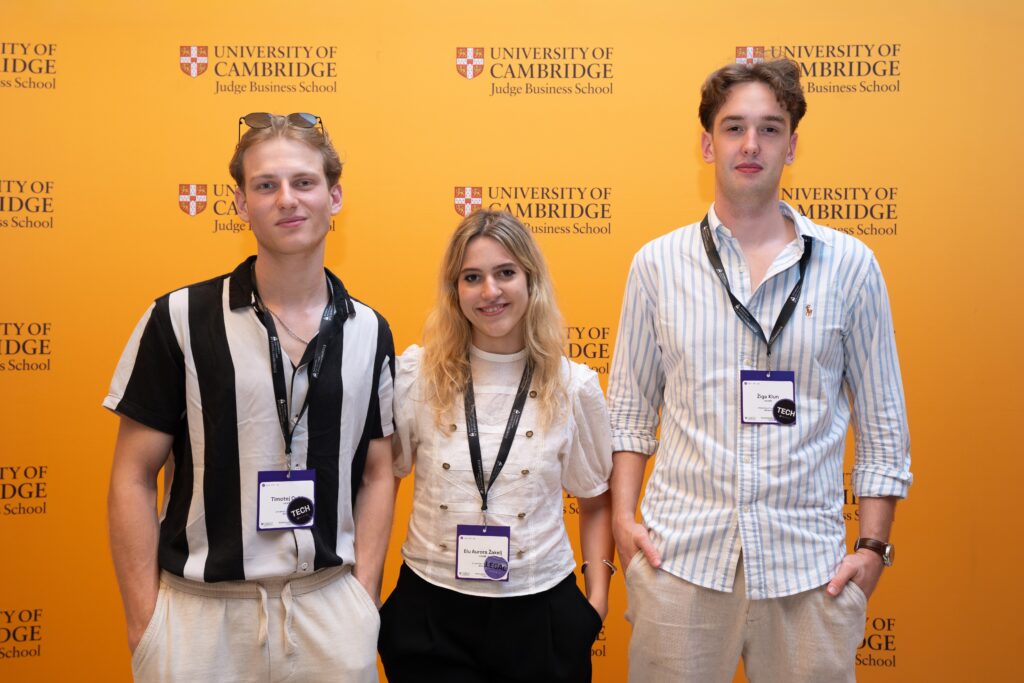
Team members: Timotej Cvikl (tech), Žiga Klun (tech), Elu Aurora Žakelj (law)
Certum makes AI-drafted legal documents reviewable without bias. It parses the argument into a dependency graph of claims, then asks the lawyer a series of targeted, blind questions—never revealing what the document actually claims—so their answers can’t be anchored by the AI’s own framing. Each answer is compared against the document to confirm it or flag a contradiction, and that result propagates across every claim that logically depends on it, so a single question can clear or flag an entire branch of the argument at once. The result is a review process that is both unbiased and highly efficient: by exploiting the logical structure of the argument, Certum surfaces the contradictions that matter while sparing the lawyer from re-checking every claim by hand.
Slides
GitHub
Demo
Challenge
Behemoth
Best Use of Google Cloud’s Platform
Tools Used: EU Publications Office’s data, Neo4j’s graph database, Anthropic’s Claude Code, Lovable, NVIDIA’s Nemotron models, Google Cloud’s Platform
Team members: Benjamin Lapostolle (tech) Ruben Dahan (tech) Daryl Lee (law)
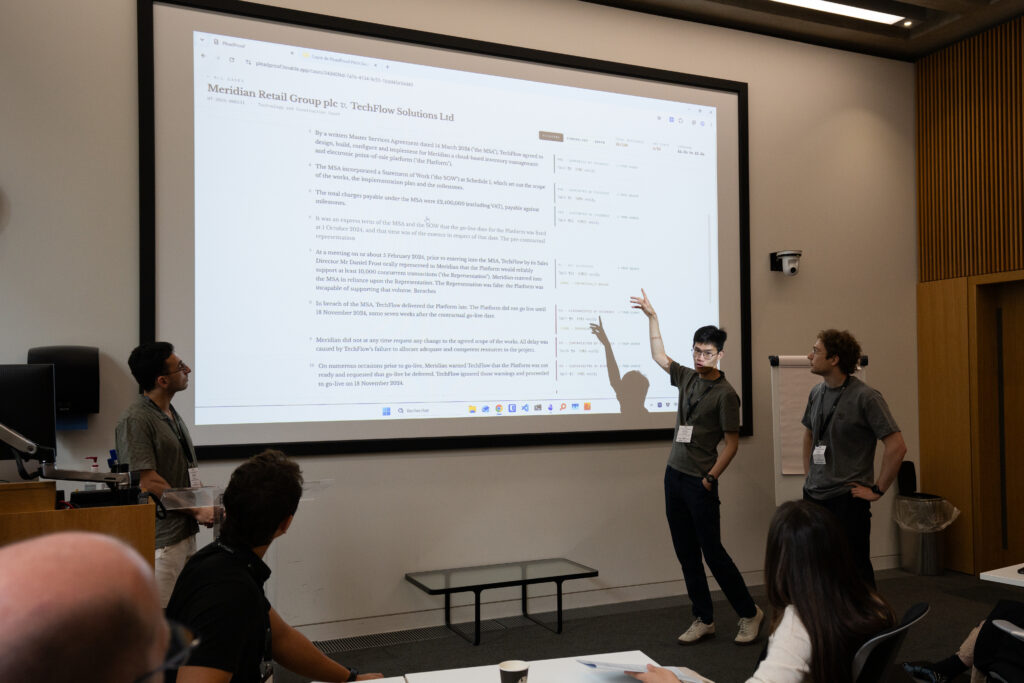
PleadProof is an intelligent legal-tech solution that replaces brittle semantic search with a cross-evidence knowledge graph to detect logical contradictions and evidentiary gaps across massive case bundles. Traditional AI retrieval relies on simple vector similarity, which routinely misses nuanced legal connections and fails to bridge multimodal data—such as matching a text statement to a specific timestamp in a video. PleadProof solves this by decomposing the case into a dynamic graph where nodes represent individual claims and multi-format evidence (text, images, video), while edges capture deep, LLM-evaluated logical relationships like support, insufficiency, or direct contradiction. By proactively instructing targeted models to evaluate how pieces of evidence interact—using a witness statement’s specific details to query and analyse a raw video file, for instance—PleadProof surfaces critical contradictions rather than letting them slip away in the context window.
Slides
GitHub
Demo
Challenge
Attica
Winner of Clio challenge
Tools Used: Anthropic’s Claude Code, Lovable, NVIDIA’s Nemotron models
Team members: Laksshini Sundaramoorthy (Law), Nikita Strukov (Tech)
Attica is a non-proprietary citator that improves access to justice for self-represented litigants, in-house counsel, academics, and others who need to know whether a given decision remains good law. Its distinguishing feature is issue-by-issue analysis: rather than treating judgments as monolithic, Attica segments judicial decisions according to the legal issues they address, mirroring the way lawyers analyse cases in practice and revealing precisely which holdings still stand and which have been disturbed. Built as an open, non-proprietary tool, it lowers a barrier that has long kept authoritative citation analysis behind expensive commercial paywalls. The demo runs on an Australian case law database but is designed to be modified for other jurisdictions.
Slides
GitHub
Demo
Challenge
Cite Me Right
Best use of Anthropic’s Claude Code
Tools Used: Anthropic’s Claude Code, Google Cloud’s Platform
Team members: Maxim Gusev, Samuel Bartlett, Pruthvirajsinh Zala, Stefanos Palyvos
CiteMeRight is an open, AI-powered citator that answers the question every legal argument depends on: is this authority still good law—and how far can you rely on it? Rather than treating a precedent as simply good law or not, CiteMeRight reads the citation graph—the network of later opinions that cite and treat a case—and reconstructs how its authority has actually evolved. Beyond a binary flag, it maps treatment by weight, context, and direction of travel, capturing not just whether a case has been followed or doubted but how decisively and in what circumstances. This closes a gap that hallucination-focused tools miss, giving both lawyers and legal AI a current, contextual, and verifiable picture of the law.
Slides
GitHub
Demo
Challenge
recode.law
Winner of CMSxHarvey Challenge
Tools Used: Anthropic’s Claude Code
Team members: Felix Ringe (tech), Lukas Flechsel (tech), Marco Magacs (law), Narmin Khabari (law)
Achilles stress-tests whether a pleaded case can actually be proved on the evidence, and re-runs the moment that evidence changes. Litigation runs for years: disclosure lands, witnesses are exchanged, new documents arrive, and whether each pleaded proposition still holds shifts underneath the team. Achilles maps every pleaded proposition to its supporting and adverse evidence, watches by re-running the instant a new document arrives, and steers by showing exactly what just changed about how provable the case is. Rigour comes from orchestration: when the bundle grows, several agents run at once, each reading across the whole corpus independently; when an agent is unsure, it escalates to a reviewer agent or a human; every judgment is backed by verbatim quote-matching so findings trace to source with no hallucination; and a confidence score drawn from token log-probabilities and other metrics flags what warrants a second look. At the top of the market everyone is excellent and nobody wins by being twice as good—so Achilles finds the 1% in a team’s own evidence that humans can’t catch, continuously, before the opponent does.
Slides
GitHub
Demo
Challenge
TESTIMONIALS
It felt like much more than a competition: it was a space to learn, collaborate, meet talented people and explore how law and technology can create real impact. I left with new skills, new connections and a stronger sense of what is possible in this field.
Excellent organization and everyone was really kind which I really appreciate it.
Thank you for organising such a meaningful experience. Very engaging, interesting, intense and exciting!
The participants and their projects changed my view of the world positively more than any other prior similar event.
Thank you for organizing such a high-quality event. The days were rather tiring but I really enjoyed them 😊
It was one of the best hackathons I’ve attended—not only because of the technical challenge, but also because of the welcoming community and the opportunity to collaborate with talented people from different disciplines and countries.